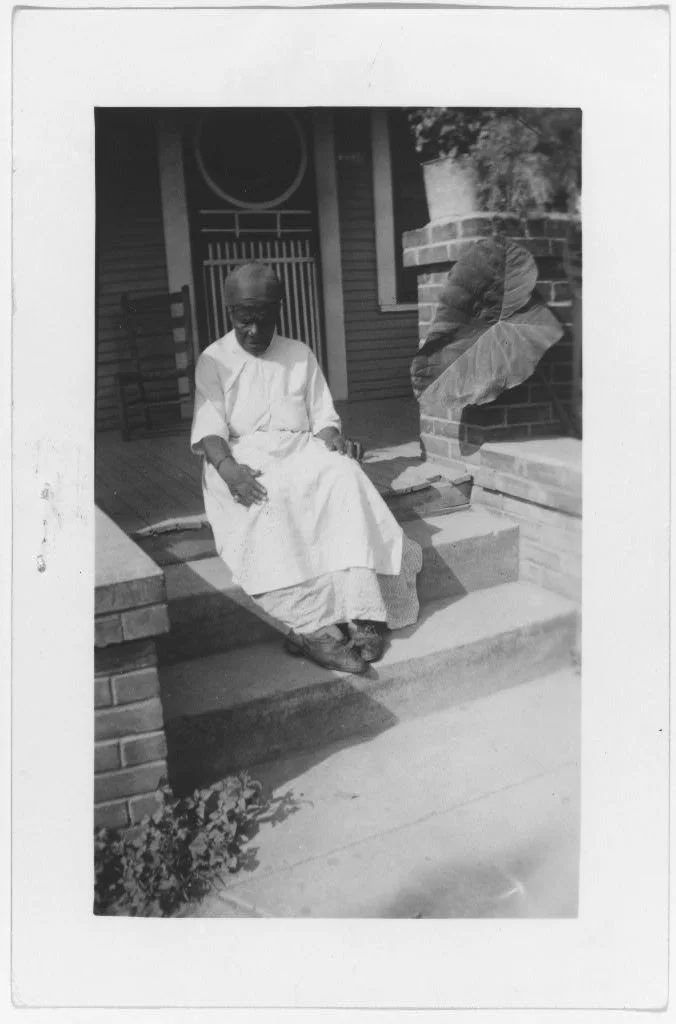
Mary Armstrong
by Chloe Hurren
Name of interviewee: Mary Armstrong (Formerly Mary Adams)
Age at emancipation: 17 years old
’Race’: Black
Year of interview: 1937
Place of interview: At Mary Armstrong’s home in Houston, Texas
State of interview: Texas
Place of enslavement: A farm near St. Louis, Missouri then St. Louis, Chinquapin Hill, Missouri
Address of interviewee: 3326 Pierce Avenue, Houston, Texas.
‘Occupation’: Before emancipation – Housegirl/ After emancipation - Domestic Nurse
‘Occupation’ of mother: Unknown (Siby)
‘Occupation’ of father: Unknown (Sam Adams)
Size of slaveholding unit: Large (Will Adams had about 5 farms and 500 enslaved people)
Name of enslaver: William & Polly Cleveland/ Will & Olivia Adams
Name of plantation/farm: Unknown
Crop produced on slaveholding unit: Wheat, barley, rye, oats, corn & fruit.
Name of interviewer: C. H Drake.
Is this included in Rawick’s supplement series?: Yes
Blog post/analysis (c. 1000 words)
Mary Armstrong (formerly Mary Adams) was born in 1847 on a farm near St. Louis, Missouri. Her mother’s name was Siby, and their enslavers were William Cleveland and Polly Cleveland. Her father was Sam Adams but he was unfortunately separated from his family and enslaved on a farm which adjoined the Cleveland place. This however, as Armstrong states, made no difference to Old Cleveland because ‘he would never sell the man and woman and chillen to the same one.’ Armstrong’s mother was also to be separated from her, but William Cleveland was stopped by a law man and was sent back to St. Louis, where her younger sister was then born when Armstrong was 4 years old.
Tragically, Armstrongs sister died at the hands of Polly Cleveland around 9 months old, being whipped to death for crying, and this shaped much of Armstrong’s experience going forward. When she was about 10 years old, her enslavers were Miss Olivia and Mr Sam Adams at this point. Miss Olivia was Polly Cleveland’s daughter and so Armstrong still had contact with her previous enslavers. Armstrong recalls the day when Cleveland visited their home, in an attempt to inflict violence upon her. However, Armstrong picked up a rock and hit her right in the eye, busting the eyeball. She states: ‘that’s for whippin’ my baby sister to death.’ This resistance to the death of her sister reveals her grief and defiance against the dehumanising nature of slavery. Furthermore, being only 10 years old when this happened, emphasises both her courage, and the extreme forms of violence that herself and many others experienced at such a young age. The brutality and extreme cruelty of her previous enslavers is also reinforced through other references to violence and even the repeated comparisons Armstrong makes: ‘She was a Polly devil If there ever was one.’
Armstrong was young when she was sold to Miss Olivia and Will Adams, but It is unclear what age she was exactly. According to her account, they were comparatively less severe and Armstrong even praised Olivia, stating that she was kind and loved by everyone as well as Adams, who was mentioned to be a fine man. Armstrong felt close bond to them and called them pappy and mammy since they raised her as a little girl. Nevertheless, despite her improved treatment, Adams owned about five farms and 500 enslaved people, revealing the scale and cruelty of the slavery institution.
Armstrong stayed with Miss Olivia and Mr Will until she was set free in 1863 when she 17 years old. She went searching for her mother Siby, who was previously sold in Texas by William Cleveland, and was given two official papers to verify her emancipation. Armstrongs journey to find her mother can be seen in this image, featured in Abigail Cooper’s Article, The Journal of African American History.
Armstrong eventually found her mother in a refugee camp in Wharton County and stayed with her until she got married to John Armstrong when she was 24 years old in 1871. She got a nursing job for a man named Dr. Rellaford throughout the yellow fever epidemic and recalled recalled him using hot water, vinegar and mustard to treat the patients. Yet, she did watch many people die from it in 1875.
When Armstrong was around 91 years old, she was interviewed by the Works Projects Administration (WPA) in her home in Houston to retell this story. The WPA Slave Narratives were collected as part of the Federal Writer’s project, and the Texas branch (The Texas Writer’s Project) was directed by author James Francis Davis, operating from 1935 to 1943. These narratives of the formerly enslaved were primarily conducted by white and often beginner writers, especially in Texas. Therefore, it was common for these interviews to be altered as a way to manipulate their narratives, reinforcing stereotypes, promoting white supremacist ideology, and many other factors. Armstrong’s interviewer was C. W. Drake and his racial background is unknown but her interview has no clear signs of editing. Edited interviews for example may have a smooth chronological storyline, or even information omitted, such as mentions of violence, which is not the case with Armstrong’s account.
Some WPA narratives were accompanied with images of the interviewee, such as this photograph of Armstrong. This image captures her sitting on her front porch, supposedly reading a book. This particularly stands out because it was uncommon for the enslaved or formerly enslaved to read or write, due to anti-literacy laws in Missouri and the Antebellum South, up until 1865-1868. Although, considering their interviews were taken place long after these laws and emancipation, it is possible that many educated themselves. However, upon further inspection, it appears that Armstrong is not holding a book, as the object looks too thin to be a book, as well as the fact she is pointing at the pages, which indicates she may be guiding the interviewer’s attention towards photographs in a photo album. If this is perhaps a photo album, it can highlight Armstrong’s agency in the retelling of her story. Although her interview was written and edited by the interviewer, Armstrong takes control by gesturing and directing his attention to her collection of preserved memories. This also foregrounds the issue of old age and unreliable narration; looking at photographs of her life and family, perhaps helped to recall memories, if Armstrong is in-fact holding a photo album.
There is further evidence from the 1930 U.S Federal Census for Houston, Texas which opposes the idea that Armstrong is reading a book in the photograph. This record indicates that at 83 years old, she was unable to read or write, lowering the chances of the object being a book, and instead suggesting she is holding something else. While it is possible that the interviewer staged the image by positioning her with a book, this also seems unlikely when considering Armstrong’s strong sense of independence, communicated in her interview.
[1] National Park Service, National Register of Historic Places, https://npgallery.nps.gov/NRHP/AssetDetail/34d5c56f-e78f-4364-ac63-02aef4ef01ee.
[1]Gavin Wright, "Slavery and the Rise of the Nineteenth-Century American Economy," The Journal of Economic Perspectives 36, 2 (2022): 128.
[1]Bayly E. Marks, "Skilled Blacks in Antebellum St. Mary's County, Maryland," The Journal of Southern History 53, 4 (1987): 558-559.
[1] Robert H. Churchill, "When the Slave Catchers Came to Town: Cultures of Violence along the Underground Railroad," The Journal of American History 105, 3 (2018): 515.
[1] https://www.familysearch.org/en/tree/sources/viewedit/QTYV-YPG?context, accessed March 19, 2026.
[1] https://slavery.msa.maryland.gov/html/research/census1860.html, accessed March 19, 2026.
[1] Diane Kuthy, "Envisioning Freedom: Piecing Together Maryland’s Emancipation History," Art Education 75, 6 (2022): 50.
[1] https://www.familysearch.org/ark:/61903/1:1:MN33-2F6?lang=en, accessed March 20, 2026.
[1] https://www.familysearch.org/en/tree/sources/viewedit/QTTK-NBM?context, accessed March 19, 2026.
[1] Frederick Douglass, Narrative of the Life of Frederick Douglass: An American Slave (Open Road Integrated Media, Inc, 1997), 18-19.
Bibliography
Interview conducted: Houston, Texas
Interview with Mary Armstrong, Federal Writers’ Project: Slave Narratives, Vol 16, Texas, C. W, Drake, 1937. Available https://www.loc.gov/resource/mesn.161/?st=list
Ancestry.com (Accessed 14 March 2026) https://www.ancestry.co.uk/imageviewer/collections/6224/images/4547969_00543?albums=pg&isPersonGallery=true&showGalleryAlbums=true&tab=sources&pId%5B%5D=63229461&pId%5B%5D=132747814843
Abigail Cooper. “‘Away I goin’ to Find My Mamma’: Self-Emancipation, Migration, and Kinship in Refugee Camps in the Civil War Era.” The Journal of African American History 102, no. 4 (2017): 444–67. https://www.jstor.org/stable/10.5323/jafriamerhist.102.4.0444?seq=21
Mary Armstrong, ex-slave, Houston. Houston Texas United States, 1937. Aug.9. Photograph. https://www.loc.gov/item/99615228/
Mary Armstrong, ex-slave, Houston. Houston Texas United States, 1937. Aug.9. Photograph. https://www.loc.gov/item/99615229/