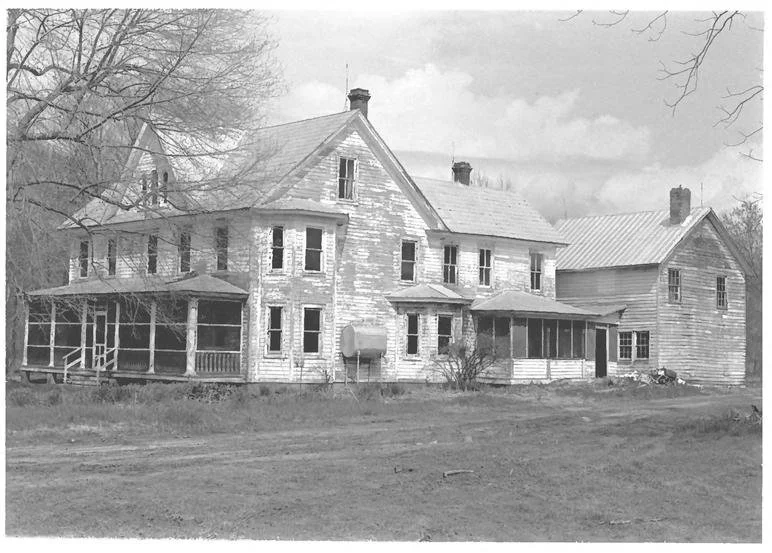
Richard Mack
by Conor Howard
Name of interviewee: Richard Mack (listed as Richard Macks in the interview).
Age at emancipation: 18-20 (estimated).
Year of interview: 7th September 1937.
Place of interview: At home, Baltimore, Maryland.
State of interview: Maryland.
Place of enslavement (there may be more than one): e.g. Pomfret, Maryland.
Address of interviewee (if given): 541 W. Biddle St, Baltimore, Maryland.
‘Occupation’: Field and around the stable.
‘Occupation’ of mother: Farming.
‘Occupation’ of father: Overseer of the plantation.
Size of slaveholding unit: Large (Listed as 14 in 1850).
Name of enslaver: Sally McPherson.
Name of plantation/farm: McPherson Farm.
Crop produced on slaveholding unit: Tobacco, Vegetables.
Name of interviewer: Rogers.
Is there evidence of editing: Yes.
Richard Mack, listed as Richard Macks in the WPA interview, was a formerly enslaved person in Maryland. In his interview, he talks about his family stating that he had he was born in the same place of his mother and father in Charles County along with a sister called Jenny. Mack shares that his mother worked mainly on the farm while his father was an overseer on the farm and also had a workbench, which he would use to mend the shoes of the other enslaved people on the farm. In the interview, Richard mentions that he would have his feet measured for shoes at the start of the season however, there was a chance of receiving ill-fitting shoes, which does corroborate the mention of his father needing to mend shoes. The other mentions that Richard makes to his family is that his father hunted and had dogs to help him, he would find money to give to his mother and there is no other mention of his sister besides the fact that she shared a bed with her mother.
Richard Mack refers to his work on the farm as being focused on the tobacco fields and collecting timber for firewood. Richard does state that tobacco was one of the largest crops produced within Maryland. The largest mainland export for the United States was tobacco in the 18th century with the main concentration of the tobacco producing farms being in Maryland.[i] In other Maryland counties, when tobacco prices started to stagnate in the 19th century, it pushed white workers into more skilled professions which limited the roles that Black Americans or enslaved people could work in.[ii] This highlights that the tobacco crop grown on the farm was large and significant to the economy of Maryland during Richard’s enslavement and why other working roles were limited while he was enslaved.
Experiences detailed in the interview give accounts of the brutality of slavery. Richard mentions an enslaved girl that was purchased by a local doctor, and she was beaten by his wife. Another story that Richard tells is that of an enslaved person that ran away from his enslaver after being whipped. The enslaved person was caught, returned and had hot wax poured across the wound he sustained from the whipping. Richard then says that the enslaved person escaped again and was never caught. Richard expands on the theme of running away saying that due to the demanding workload to produce tobacco, many enslaved people would try to escape. As a result of the enslaved running away, slave catching became a prominent business. Before the outbreak of the Civil War in 1861, many enslaved people attempted to escape to Northern states which led to over 150 times slave catchers faced resistance when trying to recover the enslaved.[iii] This shows that this was a reoccurring event which backs up Richard’s account.
In the interview, Richard talks about his enslaver being Sally McPherson on McPherson Farm. There are a couple of mentions of Sally in the interview. In one mention, Richard talks about the food he was provided to eat. He says that they were provided little meat, however Sally allowed the enslaved people to grow vegetables on a small patch on the farm. Another mention of Sally is she would only send for a doctor for an enslaved person if they were severely sick which was rare. When looking into census records, Sally McPherson had a large slaveholding unit when compared to Maryland records in the 1850 census. In 1850, Sally had a slaveholding unit of 14 enslaved people.[iv] Comparing this number to the average size of a slaveholding unit in 1860 in Maryland, which is around 6, Sally had more than double the average slaveholding unit which suggests that the size of the farm that Richard worked on was significant in size.[v]
There is no date given for Richard’s emancipation, however presuming that he was emancipated when slavery was outlawed in Maryland in 1864, he would have been 18-20 years old.[vi] He says that he moved to Baltimore when President Grant was elected. According to census data, in 1870 he was living with Olivia Mack in Baltimore and had two young children, Thomas and Harriett.[vii] Richard talks about the work that he did through his life in Baltimore working in stables, a coachman, a waiter, head butler/butler and finally in catering and he retired 12 years before the interview around the age 79-81. The interview took place in 1937 making Richard 91-93 years old at the time of the interview.
For Richard’s interview, his interviewer was listed as ‘Rogers’, with this information being the only obtainable information about his interviewer.
There are some flaws with using the WPA interviews due to the significant time period between the interviews and the events the interview discusses. One notable flaw is the difference in Richard Mack’s birth year in the interview compared to census records. In the interview, Richard states his birth year as 1844 which is at odds with census records which give him birth year of 1846.[viii] This was a common theme for formerly enslaved people as even Frederick Douglass did not know his birth year.[ix] Another flaw of the interview is that Richard is discussing events that took place from the mid-1840s to the mid-1860s over seventy years after the fact which could lead to some misremembrance when talking about his experience as a formerly enslaved person.
The transcript of the interview has some evidence of editing as the last page of the interview is formatted differently to the rest of the interview. The interview appears to be written on a typewriter however on the last page, the font changes and so does the size of the font. This could suggest that the original copy of the interview was damaged and the last page had to be copied and replaced which likely is the case.
[i]Gavin Wright, "Slavery and the Rise of the Nineteenth-Century American Economy," The Journal of Economic Perspectives 36, 2 (2022): 128.
[ii]Bayly E. Marks, "Skilled Blacks in Antebellum St. Mary's County, Maryland," The Journal of Southern History 53, 4 (1987): 558-559.
[iii] Robert H. Churchill, "When the Slave Catchers Came to Town: Cultures of Violence along the Underground Railroad," The Journal of American History 105, 3 (2018): 515.
[iv] https://www.familysearch.org/en/tree/sources/viewedit/QTYV-YPG?context, accessed March 19, 2026.
[v] https://slavery.msa.maryland.gov/html/research/census1860.html, accessed March 19, 2026.
[vi] Diane Kuthy, "Envisioning Freedom: Piecing Together Maryland’s Emancipation History," Art Education 75, 6 (2022): 50.
[vii] https://www.familysearch.org/ark:/61903/1:1:MN33-2F6?lang=en, accessed March 20, 2026.
[viii] https://www.familysearch.org/en/tree/sources/viewedit/QTTK-NBM?context, accessed March 19, 2026.
[ix] Frederick Douglass, Narrative of the Life of Frederick Douglass: An American Slave (Open Road Integrated Media, Inc, 1997), 18-19.
Bibliography
Richard Mack WPA Interview, 50-56. https://www.loc.gov/item/mesn080/, accessed March 20, 2026.
Churchill, Robert H. "When the Slave Catchers Came to Town: Cultures of Violence along the Underground Railroad," The Journal of American History 105, 3 (2018): 514-537.
Douglass, Frederick. Narrative of the Life of Frederick Douglass: An American Slave. Open Road Integrated Media, Inc, 1997.
https://www.familysearch.org/ark:/61903/1:1:MN33-2F6?lang=en, accessed March 20, 2026.
https://www.familysearch.org/en/tree/sources/viewedit/QTTK-NBM?context, accessed March 19, 2026.
https://www.familysearch.org/en/tree/sources/viewedit/QTYV-YPG?context, accessed March 19, 2026.
https://slavery.msa.maryland.gov/html/research/census1860.html, accessed March 19, 2026.
Kuthy, Diane. "Envisioning Freedom: Piecing Together Maryland’s Emancipation History," Art Education 75, 6 (2022): 50-57.
Marks, Bayly E. "Skilled Blacks in Antebellum St. Mary's County, Maryland." The Journal of Southern History 53, 4 (1987): 537-564.
National Park Service, National Register of Historic Places, https://npgallery.nps.gov/NRHP/AssetDetail/34d5c56f-e78f-4364-ac63-02aef4ef01ee.
Wright, Gavin. "Slavery and the Rise of the Nineteenth-Century American Economy," The Journal of Economic Perspectives 36, 2 (2022): 123-148.