Martha Grayson
by Emily Atkinson
Name of interviewee: Martha Grayson.
Age at emancipation: About 7.
’Race’: (as designated by interviewer or interviewee, e.g. ‘mulatto’, black’, ‘dark-skinned’, light-skinned’) Black.
Year of interview: 1940.
Place of interview: 2200 Fourth Street, Zachary.
State of interview: Louisiana.
Place of enslavement: North Carolina.
Address of interviewee: Zachary, East Baton Rouge.
‘Occupation’: Domestic, ‘real work’ as a midwife.
Size of slaveholding unit: Large (more than 20 enslaved people).
Name of enslaver: John Lipcomb (Lipscomb).
Name of plantation/farm: Lipscomb House.
Crop produced on slaveholding unit: Cotton.
Name of interviewer: Maud Wallace.
Race of interviewer: White.
Is this included in Rawick’s supplement series?: No.
Is there evidence of editing: Yes.
Martha Grayson was a witty and maternal woman who, despite being born into enslavement and raised as a domestic worker, embraced midwifery as her true calling. Grayson was passionate about her profession and spent much of her interview with Maud Wallace expressing her devotion to midwifery from a young age when she was drawn to it in her dreams. She lived in East Baton Rouge, Zachary, in a small room since her husband passed away and her children moved on.
During her interview, Grayson stated that she had just turned 88, while her interviewer, white American Maud Wallace, placed her at 86 – suggesting a miscommunication or possible editing. Extensive research uncovered a Martha Grayson in the 1930 census records from Police Ward 4, East Baton Rouge, listed as a widow born around 1856. While this would place Grayson at 84, the strong alignment between the interview details, census inaccuracies due to lack of birth records and racial bias, and the evidence of editing or miscommunication suggests this is a likely match.
Grayson was born and raised at John Lipcomb’s place by her grandmother and ‘white folks’ after her mother left with a ‘Yankee.’[i] Although her interview took place in New Orleans, with her home residence in Baton Rouge, the only traceable John Lipcomb appears to be an enslaver from North Carolina. The 900-mile distance between Louisiana and North Carolina raises the possibility that Grayson was transported through the domestic slave trade, or that she relocated to Zachary after emancipation.
Another uncertainty arises from the discrepancy between ‘Lipcomb’ and ‘Lipscomb.’ While Grayson referred to ‘Lipcomb House,’ most census records list the name as ‘Lipscomb,’ except for one instance where ‘Lipcomb’ remains unchanged. This variation may have resulted from Maud Wallace‘s phonetic transcription of Grayson’s speech, reflecting racial biases and misrepresentations found in many Federal Writers Project interviews. It may also suggest that Grayson, whose 1930 census record indicates she could not read, had only ever heard her enslaver’s name rather than seen it written.[ii] Despite these inconsistencies, John Lipscomb at Lipscomb House remains the most likely match for Grayson’s enslaver.
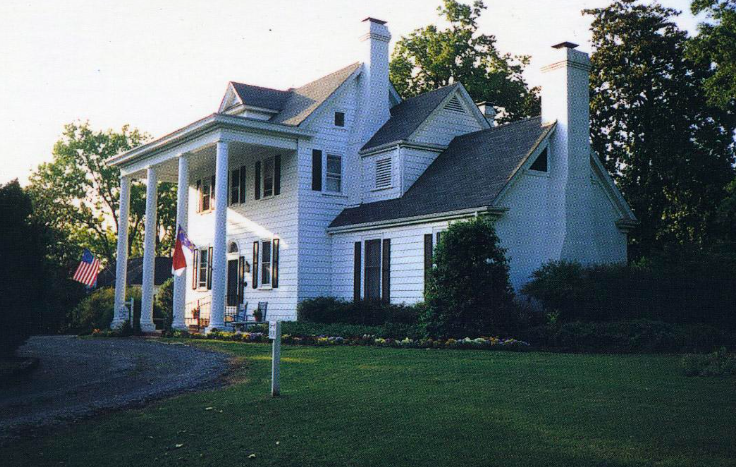
John Lipscomb’s Federal style-plantation sits on 2,000 acres in Durham, North Carolina. Lipscomb house was considered one of the largest cotton farms in Durham County, producing 90 percent of the county’s cotton. The Lipscomb family, therefore, were an extremely wealthy family with much of their correspondence, financial records, legal documents, and personal writing available at the University of North Carolina Library.[iii] Lipscomb house is now the Arrowhead Bed and Breakfast Inn, with a short history of the Lipscomb plantation’s enslaved people available to guests at the Bed and Breakfast.
Grayson gave birth to fifteen children, raised nine of them, but by the time of her interview in 1940, only five were still alive. In addition to her own children, she also took on and raised another woman’s baby when the mother was unwilling to do so. This indicates that the six children she did not raise may have been taken from her through the domestic slave trade, as her nurturing nature makes it likely she would have wanted to care for them herself.
Her interview took place at 2200 Fourth Street, New Orleans, while she was visiting following the death of her unbiological son in a railroad accident at work. Grayson had a strong relationship with him as he often visited her, helped with various tasks and provided financial assistance, including his insurance money. This reinforces Grayson’s caring nature and highlights the deep appreciation her unbiological son had for the upbringing she provided. This also sheds light on the hazardous conditions of the railroad industry and the systematic neglect faced by Black American workers.[iv]
Grayson spent her later years in Zachary as the fast-paced city life did not appeal to her and she enjoyed being barefoot when delivering babies for what she called ‘howling women.’[v] Grayson resisted the governments encouragement to adopt the white apron, cap, and shoes required for midwives as she did not like to be confined and insisted on staying grounded, both physically and spiritually. This reflects the lasting impact of clothing restrictions during enslavement, as many formerly enslaved individuals struggled to adjust to ‘free people’s clothing’ after emancipation.[vi]
Grayson also disliked broader medicalisation of midwifery in the 20th century, with the introduction of medicines such eye drops, regulations, and formal training highlighting how the medical establishment pushed Black midwives out of the profession in favour of white male doctors. [vii] Despite Grayson’s extensive knowledge of herbal medicines and traditional healing practises, using remedies like eggshell tea to induce labour and castor oil to aid delivery, they were devalued and erased, replaced by doctors who labelled midwives as ‘ignorant.’[viii]
Despite government attempts to push Black midwives out, Grayson, known as ‘granny Grayson’ in her community, was still called upon to deliver their babies.[ix] This highlights the intersectionality of race and gender, as whilst the ‘granny’ stereotype acknowledged the centrality of Black women to their communities, it also reduced them to a single role of caregiver with the expectation to be the backbone of their community.[x]
Though much of Grayson’s interview focused on her role as a midwife, her light-hearted and playful personality also shone through when she proudly displayed her ‘pretty’ new teeth she bought for just $12 through a church advertisement.[xi] This not only reflected Grayson’s sense of humour but also reinforced that beyond being a strong and nurturing figure who dedicated herself to others, she valued self-care and personal joy.
[i] Interview with Martha Grayson conducted by Maud Wallace, in A. Livesey, Voices of the Formerly Enslaved in Louisiana: The WPA Interviews, Baton Rouge: Louisiana State University Press [forthcoming 2025].
[ii] 1930 United States Federal Census, Ancestry.com (1930 United States Federal Census), East Baton Rouge, Louisiana, United States. Martha Grayson, (Date Accessed 19/03/2025).
[iii]Lipscomb Family Papers, 1791-1926,’ Southern Historical Collection, Wilson Special Collections Library, University of North Carolina Library (Date Accessed 19/13/2025).
[iv] Joe William Trotter, ‘Brotherhoods of Color: Black Railroad Workers and the Struggle for Equality,’ Journal of American History 88:4 (March 2002), 1581.
[v] Interview with Martha Grayson conducted by Maud Wallace, in A. Livesey, Voices of the Formerly Enslaved in Louisiana: The WPA Interviews, Baton Rouge: Louisiana State University Press [forthcoming 2025].
[vi] Emilia Salcido, ‘The Hierarchy of Dress: Clothing in the Age of Emancipation,’ The Undergraduate Journal of History 2:2 (October 2022), 67.
[vii] Alicia D. Bonaparte, ‘”The Satisfactory Midwife Bag”: Midwifery Regulation in South Carolina, Past and Present Considerations,” Social Science History 38:2 (Summer 2014), 177.
[viii] Christa Craven, Mara Glatzel, ‘Downplaying Difference: Historical Accounts of African
American Midwives and Contemporary Struggled for Midwifery,’ Feminist Studies 36:2
(Summer, 2010), 339.
[ix] Interview with Martha Grayson conducted by Maud Wallace, in A. Livesey, Voices of the Formerly Enslaved in Louisiana: The WPA Interviews, Baton Rouge: Louisiana State University Press [forthcoming 2025].
[x] Bonaparte, ‘The Satisfactory Midwife Bag,’ 177.
[xi] Interview with Martha Grayson conducted by Maud Wallace, in A. Livesey, Voices of the Formerly Enslaved in Louisiana: The WPA Interviews, Baton Rouge: Louisiana State University Press [forthcoming 2025].
Bibliography
Leighton, Clare, Artist. The Old Law and the New Law. Georgia, 1946. The Library of Congress. Photograph. (Date Accessed 19/03/2025) https://www.loc.gov/item/2020630206/.