Pauline ‘Pearl’ Howell
by Evie Bibby
Age at emancipation: Born after emancipation
’Race’: Not specified. Although, she describes her mother as a “black guinea woman,” whilst her father's biological father/enslaver was white, so can infer that she is of mixed heritage.
Year of interview: Between 1936 and 1938
Place of interview: Brinkley
State of interview: Arkansas
‘Occupation’ of mother: Wet Nurse
Name of interviewer: Irene Robertson
Race of interviewer: White
Is there evidence of editing: Yes
Pauline (Pearl) Howell states that she was born in Paris, Tennessee, later arriving in Arkansas when she was still a child, with her and her brother still residing there at the time of her interview.[i] Due to her mother's recent passing, she no longer has access to the exact year of her birth but believes it to be not long after the civil war and therefore was born after emancipation took place.[ii]
Howell provides little detail regarding her childhood unless it is in conjunction with another family members experience, and even less regarding her adult life therefore leaving no trace on other forms of documentation such as census data or death certificates.[iii] This may have been an intentional choice by Howell due to distrust of government officials who would have taken this subsequent data, as her address was not included within her interview like others conducted by the same interviewer, Irene Robertson.[iv] However, from what she does disclose it would be fair to assume that she was married or widowed at the time of her interview, as she discusses the passing of her son as well as appearing to have changed her surname from Travis to Howell as that remains her brothers' surname.[v]
Throughout her interview, Howell chooses to primarily focus upon the experiences of her formerly enslaved mother and father, with further mentions to other family members such as her maternal grandmother, and brother. Howell’s testimony provides and incredible level of insight regarding distinct aspects of planation life and the institution of slavery, such as gender specific labour and race.
Although she does not state her name, Howell speaks frequently of her mother stating that she was born in Oaks, Tennessee in which she resided in one of the many identical cabins located on one of the “several farms” owned by her enslavers, suggesting a large slave holding. [vi] Furthermore, Howell recalls her both her mother and grandmother's roles on the aforementioned slaveholding, with her grandmother acting as a cook for the white residents and enslavers while her mother was a wet nurse, both of which were gender specific forms of labour.[vii] In particular, Howell states that her mother cared for what was presumably her mistress's son as well as many others in the surrounding area of Memphis leaving her exhausted, highlighting the practice of wet nursing as a core aspect of white southern motherhood.[viii]
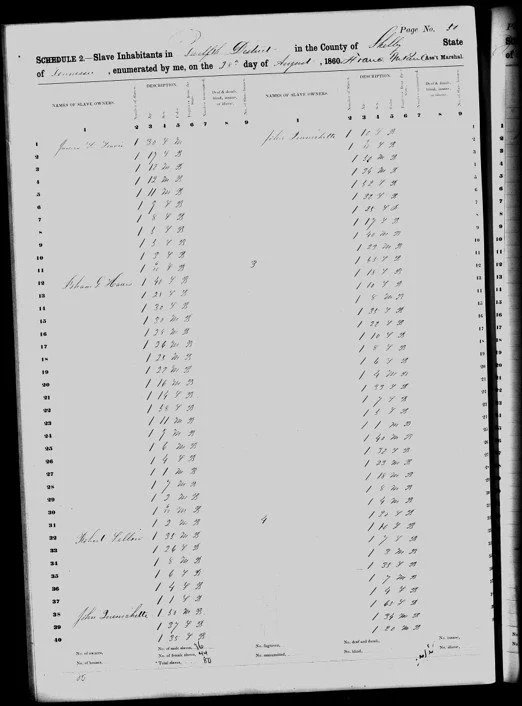
Howell also speaks of her father who was enslaved on a large slaveholding in Shelby, Tennessee by Isham Green Harris (referred to by Howell as George Harris) who held office as the Governor of Tennessee.[ix] Moreover, Howell also reveals that Harris was the biological of her father, aunt, and uncle Jesse despite being married to Martha Harris (formerly Travis) and having 9 boys of their own.[x] The only substantial detail Howell gives regarding her father's life and experience at the slaveholding in Shelby is that he was sent by Harris to Liverpool, England in an attempt to ”bury his money”, further emphasising Liverpool's historic link with the institution of slavery due to it being a port city.[xi]
Howell was interviewed by Irene Robertson, of whom worked in Arkansas as both a writer and an interviewer for the Federal Writers’ Project throughout the mid 1930’s.[xii] Although there is some obvious editing to Howell’s interview such as formatting of text, heading and page numbers, it primarily consists of direct quotes which is in keeping with Robertsons style across the interviews she conducted.[xiii] Whilst Robertson has faced criticism in regard to interviews for reportedly “stirring things up,” I would argue that in having this style the testimony and experiences shared by the interviewee(s) remains as close to what they intended as possible.[xiv]
[i] Library of Congress, Pauline (Pearl) Howell Interview, 341, https://www.loc.gov/resource/mesn.023/?sp=342&st=image&r=-1.241,-0.044,3.481,1.445,0.
[ii] Library of Congress, Pauline (Pearl) Howell Interview, 341, https://www.loc.gov/resource/mesn.023/?sp=342&st=image&r=-1.241,-0.044,3.481,1.445,0.
[iii] Library of Congress, Pauline (Pearl) Howell Interview, 341, https://www.loc.gov/resource/mesn.023/?sp=342&st=image&r=-1.241,-0.044,3.481,1.445,0.
[iv] Library of Congress, Pauline (Pearl) Howell Interview, 341, https://www.loc.gov/resource/mesn.023/?sp=342&st=image&r=-1.241,-0.044,3.481,1.445,0
[v] Library of Congress, Pauline (Pearl) Howell Interview, 343-344, https://www.loc.gov/resource/mesn.023/?sp=342&st=image&r=-1.241,-0.044,3.481,1.445,0.
[vi] Library of Congress, Pauline (Pearl) Howell Interview, 341, https://www.loc.gov/resource/mesn.023/?sp=342&st=image&r=-1.241,-0.044,3.481,1.445,0.
[vii] Library of Congress, Pauline (Pearl) Howell Interview, 341, https://www.loc.gov/resource/mesn.023/?sp=342&st=image&r=-1.241,-0.044,3.481,1.445,0.
[viii] Library of Congress, Pauline (Pearl) Howell Interview, 341, https://www.loc.gov/resource/mesn.023/?sp=342&st=image&r=-1.241,-0.044,3.481,1.445,0.
[ix] Library of Congress, Pauline (Pearl) Howell Interview, 341, https://www.loc.gov/resource/mesn.023/?sp=342&st=image&r=-1.241,-0.044,3.481,1.445,0.
[x] Library of Congress, Pauline (Pearl) Howell Interview, 342, https://www.loc.gov/resource/mesn.023/?sp=342&st=image&r=-1.241,-0.044,3.481,1.445,0.
[xi] Library of Congress, Pauline (Pearl) Howell Interview, 342, https://www.loc.gov/resource/mesn.023/?sp=342&st=image&r=-1.241,-0.044,3.481,1.445,0.
[xii] Library of Congress, Pauline (Pearl) Howell Interview, 341, https://www.loc.gov/resource/mesn.023/?sp=342&st=image&r=-1.241,-0.044,3.481,1.445,0.
[xiii] Library of Congress, Pauline (Pearl) Howell Interview, 341-344, https://www.loc.gov/resource/mesn.023/?sp=342&st=image&r=-1.241,-0.044,3.481,1.445,0.
[xiv] Profile of Miss Irene Robertson: https://encyclopediaofarkansas.net/entries/irene-robertson-3232/.
Bibliography
First Message of Governor Isham Harris to the Tennessee Assembly - https://civilwarcauses.org/harris.htm - (Last accessed 20 March 2026)
Hannah Travis in the 1910 United States Federal Census: https://www.ancestry.co.uk/search/collections/7884/records/188902866?_gl=1*1t9kmb*_up*MQ..&gclid=f4543b7bb76d1e647b3752c6be954772&gclsrc=3p.ds - (Last accessed 20 March 2026)
Isham G Harris Census (Slave Schedule), 1860: https://www.familysearch.org/ark:/61903/1:1:WKT5-4YZM?lang=en - (Last accessed 20 March 2026)
Library of Congress, Hannah Travis Interview: https://www.loc.gov/resource/mesn.026/?sp=351&st=image&r=-0.676%2C0.636%2C1.59%2C1.59%2C0 - (Last accessed 16 March 2026)
Profile of Miss Irene Robertson: https://encyclopediaofarkansas.net/entries/irene-robertson-3232/.
Profile of Martha Mariah Travis: https://www.familysearch.org/en/tree/person/about/9F6N-X6N
Isham G Harris Census (Slave Schedule), 1860, https://www.familysearch.org/ark:/61903/1:1:WKT5-4YZM?lang=en.
Stephanie Jones-Rogers, “‘[S]he could … spare one ample breast for the profit of her owner’: white mothers and enslaved wet nurses’ invisible labor in American slave markets, "Slavery & Abolition 38:2 (2017): 338.
Library of Congress, Hannah Travis Interview, 346, https://www.loc.gov/resource/mesn.026/?sp=351&st=image&r=-0.676%2C0.636%2C1.59%2C1.59%2C0.