William ‘Bill’ Simms
by Laura Clark
Name of interviewee: William ‘Bill’ Simms
Age at emancipation: (approx.) 35
’Race’: Black
Year of interview: 1936
Place of interview: Ottawa
State of interview: Kansas
Place of enslavement: Osceola, St. Claire County, Missouri
Address of interviewee: Topeka, Kansas
‘Occupation’: Field/labourer
‘Occupation’ of mother: Enslaved
‘Occupation’ of father: Unknown
Size of slaveholding unit: Small (John D. Simms enslaved 10 people)
Name of enslaver (there may be more than one): John D. Simms
Name of plantation/farm: Unknown
Crop produced on slaveholding unit: Cotton, tobacco and corn
Name of interviewer: Leta Grey
Race of interviewer: White
Is there evidence of editing: No
William ‘Bill’ Simms was born in Osceola, Missouri on the 16th of March 1839 on a farming plantation near the Santa Fe Trail, owned by John D. Simms. Simms had no other family living with him on the farm, other than his mother and his enslaver as his sister, and her three children were sold for around $1600 USD because the enslaver needed extra money. After Simms was separated from his sister, he was never able to see her again properly as she had moved away to a different plantation. Although it was not possible to find the exact address of the plantation that Simms was enslaved at, it can be inferred by the number of enslaved people (10) and the amount of acreage of land that his enslaver had, that Simms was working for a wealthy family. His enslaver’s wife had died many years before Simms was born and they had no children or close relatives other than a nephew who wanted his land, afraid that he would give it to the enslaved people. Although Simms did not say who shot the nephew, it could be suggested that from the terminology he used, it was the enslaved people who did this, but they would have been told to by the enslaver.
Simms, as a young boy, learned how to make shoes for the family and would also make his own clothes by spinning wool from the sheep that he looked after on the farm. Alongside this, he would also chop wood to make rails for the enslaved houses. These houses consisted of two rooms made from lumber from the woods nearby and were considered quite large at the time (although it is not certain how many enslaved people would share these houses or how many there were on the plantation).
When the civil war started in 1861, Simm’s enslaver sent him off to join the Confederate army where he used artillery weapons and lead groups of men for approximately three years, until the Union army pressed them, and he moved back to the plantation in Missouri. He then later joins the Union army when they came close enough to run away from the plantation, and fought with them by driving military machinery and wagon work for the remainder of the war. He returned to his mother and enslaver in 1865, who had remained in Missouri for the entirety of the war.
Simms appeared to have had a more positive relationship with his enslaver, as he allowed for Simms and his mother to own land (40 acres) on his plantation, which also contained a cabin to rest and timber to lumber and make money from. However, Simms memory at the time of the interview may have played a significant factor in the lack of negative experiences, as he was 97 years old when the interview was conducted and possibly only wanted to express his life through positive memories instead of other potential abuses. This can be seen through a majority of the WPA Born in Slavery interviews where they either forget events, due to being older in age, or perhaps because they do not want to remember the difficulties they faced. Further evidence of this is shown in approximately 1872 when Simms and his mother left the plantation to move on to Claire County, Kansas. Simms gives no explanation as to why he left or if he was even allowed to, showing that he may have withheld small details relating to his enslaver.
Simms married in approximately 1870 when he was 30 years old, in Ottawa, Kansas to a woman named Elizabeth “Lizzie” Boden, who was born in Georgia and also a formerly enslaved person. In the interview, Simms talks about how his enslaver valued him and called him “good and husky”[i] while refusing to sell him. This could suggest that his enslaver wanted to keep Simms as he was good for breeding and could provide sufficient offspring for the plantation, which could produce more money, either through labour or auction. Although Simms does not specifically say if this happened to him, evidence from the time would support this idea of forced breeding. Simms also talks about marriage on the plantation, which helps to give insight to something he may have experienced if he did not leave to Kansas, suggesting that the reason he left was to escape forced marriage to another enslaved woman on a Missouri plantation. [ii]
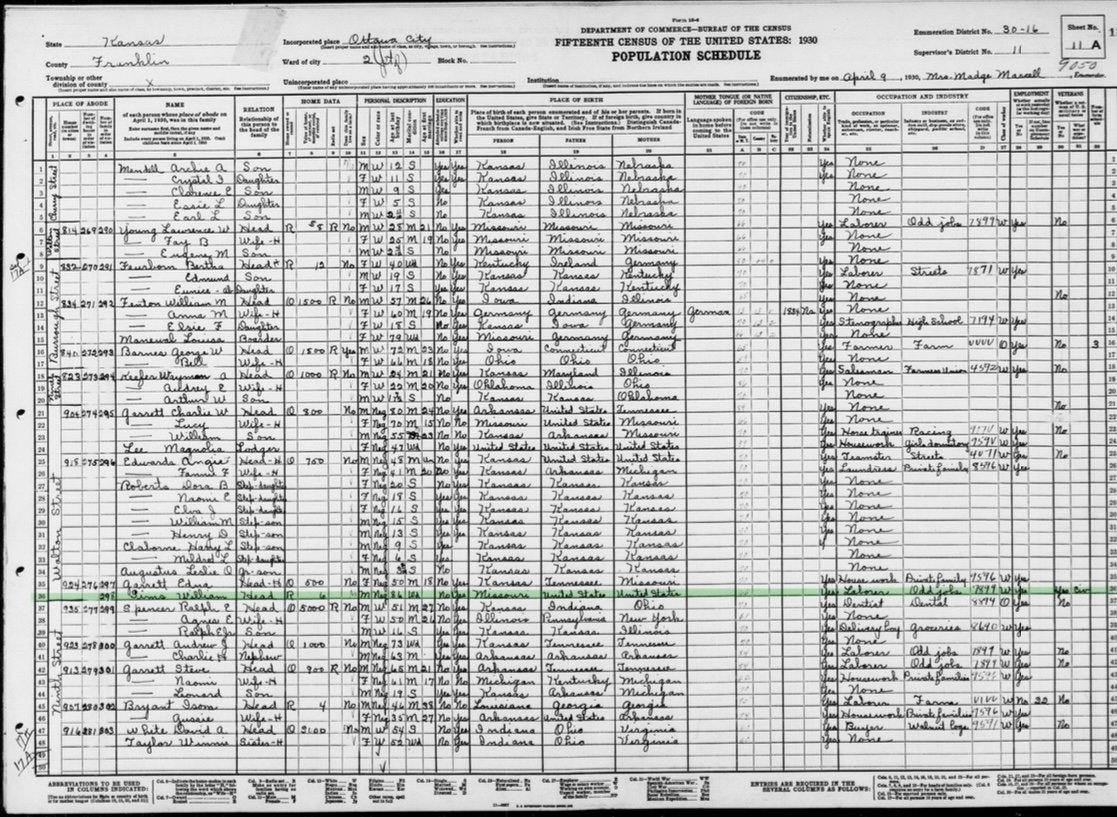
Simms did not attend school as a young boy as shown by the 1930 census, however, when he was in Ottawa, he was a deacon and attended the Ottawa African Methodist Episcopal (A.M.E) Church. In 1898, he helped to set up a night school for black youths and adults similar to the one he attended earlier in life.
Simms and his wife had three children, Mary F. Simms, Grace Bell Elizabeth Simms (Butler) and Fanny Simms. He ensured that his girls were able to get an education even by paying for their tuition, because his wife never wanted them to work as hard as she did, and he kept his promise. His two oldest daughters (Mary and Grace) attended Ottawa University and the oldest (Mary) according to Simms, was the first black girl to graduate from the university. She went on to become a teacher in Oklahoma for $125 USD a month. Simms no longer needed to support her and instead got gifted his first ever suit of clothes. Similarly, Grace also became a teacher before moving to Oklahoma, where she married a farmer. There is unfortunately no data on the youngest child.
Simms lived alone from then on, but still worked up until around 1932-33 planting trees in Ottawa, Kansas. He died in 1937, age 98, and was buried in Hope Cemetery Ottawa, alongside his wife on December 28th, 1938.
Simm’s interview is able to give us insight on how the formerly enslaved lived in Missouri, while being separated from their family and potentially having to move away to escape forced breeding and marriage. However, it also shows how he was able to build a better life not only for himself, but also his wife and three children.
[i] Federal Writers' Project: Slave Narrative Project, Vol. 6, Kansas, Holbert-Williams. 1936. Manuscript/Mixed Material, pp. 8.
[ii] Will, E. Thomas, Weddings on Contested Grounds: Slave Marriage in the Antebellum South, The Historian, Vol. 62, No. 1 (Autumn, 1999), pp. 99-117.
Bibliography
Online sources
Hope Cemetery, https://www.findagrave.com/cemetery/92735/hope-cemetery#view-photo=1969558, accessed Wednesday 19th March 2025.
Kansapedia, William "Bill" Sims, Kansas Historical Society, https://kansashistory.gov (May, 2017), accessed Tuesday 18th March 2025.
Ottawa African Methodist Episcopal (A.M.E) Church, https://www.faithstreet.com/church/st-paul-ottawa-a-dot-m-e-church-ottawa-ks, accessed 19th March 2025.
WikiTree, William Simms, https://www.wikitree.com/wiki/Simms-2168#Comments , accessed Tuesday 18th March 2025.
Primary Sources
Federal Writers' Project: Slave Narrative Project, Vol. 6, Kansas, Holbert-Williams. 1936. Manuscript/Mixed Material. https://www.loc.gov/item/mesn060/.
Ottawa, Kansas 1930 Census, “Kansas, Kansas, United States records," images, FamilySearch https:// www.familysearch.org/ark:/61903/3:1:33S7-9R4P-H8W?view=index , image 271 of 1137; United States. National Archives and Records Administration, accessed Wednesday 19th March 2025.
Secondary Sources
Will, E. Thomas, Weddings on Contested Grounds: Slave Marriage in the Antebellum South, The Historian, Vol. 62, No. 1 (Autumn, 1999), pp. 99-117.