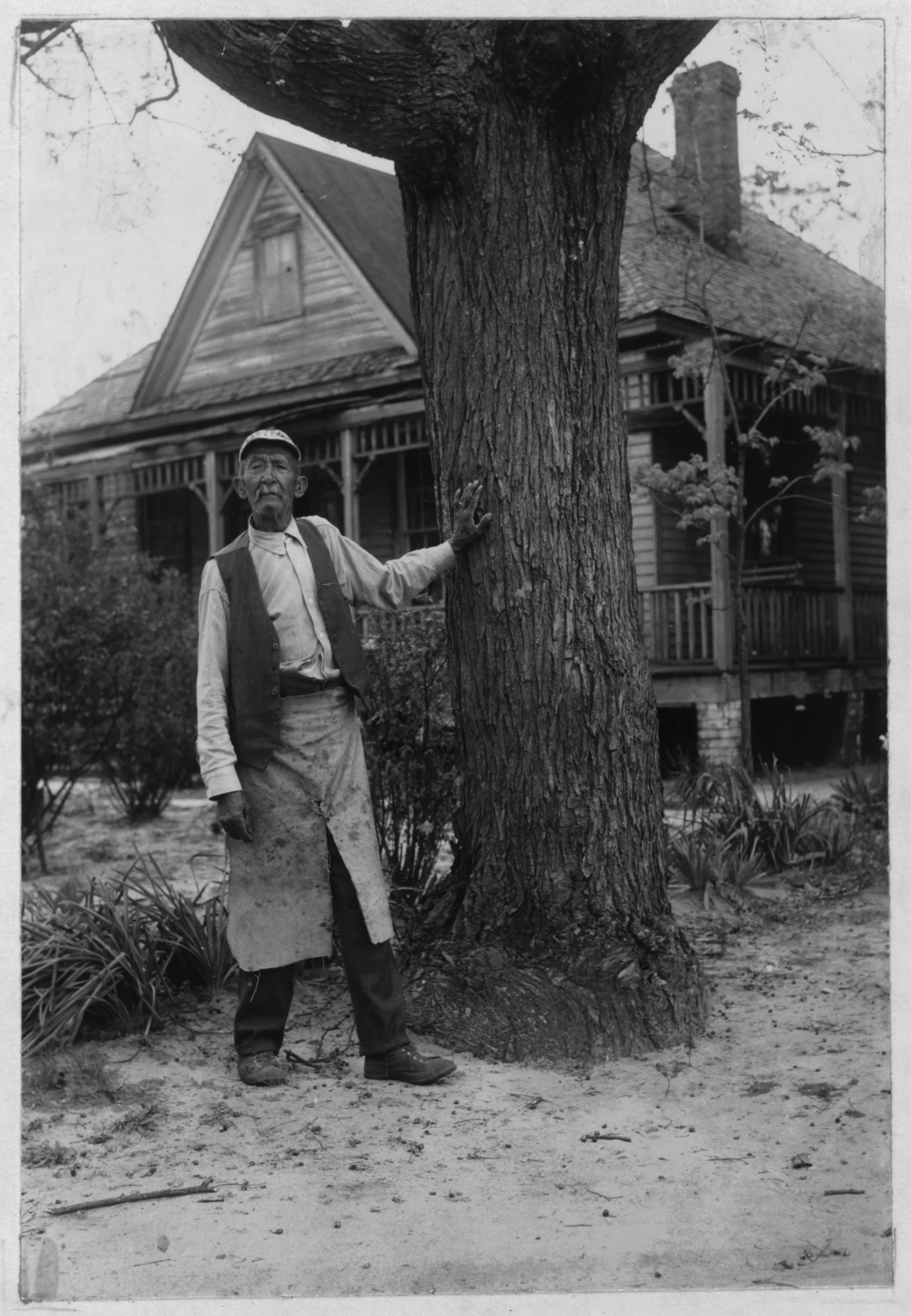
J. Augustus Askew
by Lily Slade
Name of interviewee: J. Augustus (Gus) Askew
Age at emancipation: Approximately 4 years old
’Race’: Black
Year of interview: 1935
Place of interview: Gus’s home in Eufaula
State of interview: Alabama
Place of enslavement: Henry County and Eufaula, Alabama
Address of interviewee: Eufaula, Alabama
‘Occupation’: Field
‘Occupation’ of mother: Housekeeper
‘Occupation’ of father: Blacksmith
Size of slaveholding unit: Small
Name of enslaver: James J. Edwards
Name of plantation/farm: N/A
Crop produced on slaveholding unit: Cotton
Name of interviewer: Gertha Couric
Race of interviewer: White
Is there evidence of editing: Yes
Augustus Askew, better known as Gus, was interviewed in 1935 by Gertha Couric as part of the Federal Writers' Project. This project was initiated by the government during the Great Depression. It provided members of the public who were struggling financially with a paid opportunity to conduct interviews with formerly enslaved individuals. In Askew’s interview, he discusses what he remembers from his childhood in enslavement, the Civil War, and his life after emancipation.
Askew was born in Henry County, Alabama, in 1961. In the interview, Askew’s birth year is given as 1853; however, his early census records indicate that his birth year was 1861.[i] Every year of census records for Askew was accessible, apart from 1890, which was because the 1890 census records for Alabama were lost to a fire in 1921.[ii] These records show that as Askew got older, his memory of his birth year differed. For example, in 1910, his age is recorded as 48, which would make his birth year approximately 1862. However, in 1930, he reported his age as 76, suggesting a birth year of approximately 1854.[iii] Regardless of his age during enslavement, Askew’s testimony is valuable for understanding enslaved experiences and sheds light on his childhood under slavery in the Deep South.
Askew reflects briefly on his childhood in enslavement, recalling long days picking cotton and being denied the chance to “play.”[iv] His muted recollection suggests discomfort in sharing these experiences or limitations in Couric’s interviewing; however, it confirms that enslavers stole both physical and emotional freedoms of childhood from enslaved people through forced labour.
Another flaw in Couric’s interview is her failure to include Askew’s full testimony. His account shifts quickly, and only fragments of his recollection appear, often filtered through Couric’s own voice. This reduction reflects the racial hierarchy of the US in the 1930s under the oppressive Jim Crow laws that legalised racial segregation. The segregation and accompanying beliefs are evident in Couric’s separate comments about the number of white and Black friends Askew had.[v] Research also shows that her father was an enslaver and a Confederate soldier, suggesting that inherited beliefs about race may have shaped her interviewing style.[vi] Although it seems that Couric treated Askew with respect, she likely removed parts of his testimony to obscure the institution her family once supported.
Her position as a widowed member of the Writers Project suggests she was financially insecure, which may have also influenced the interview, especially in contrast to Askew’s relative success.[vii] The interview omits her questions entirely and frequently replaces Askew’s voice with her own commentary. For instance, she identifies the family who enslaved Askew as the Edwards family of Henry County but offers no further detail, further diminishing the authenticity of his testimony.[viii]
Extensive research identifies James as the head of the Edwards family, with the 1850 and 1860 Slave Schedules confirming him as the enslaver. Both documents contain a record of enslaved people of the same age as Askew’s mother, Mary Askew and father, Paton Askew.[ix] Unfortunately, the names of the enslaved people were not noted on either document because they were deemed to be property, not humans. However, further research identified that Edwards was born in Georgia and moved to Alabama.[x] The 1870 census shows that Mary and Paton Askew were also born in Georgia, likely under enslavement by Edwards and brought to Alabama with him, serving as further evidence that he was the enslaver.[xi]
Askew goes on to discuss his experience of the Union soldiers coming to Eufaula at the end of the Civil War. He mentions negative feelings of paranoia, fear and disbelief at the possibility of freedom, feelings which demonstrate the negative effect that enslavement had on the minds of innocent children. However, Askew went on to confirm his happiness after emancipation by acknowledging that he had lots of time to play. Census records show that Askew moved back to Henry County with his parents and younger brother, Paton Askew, where his father worked as a blacksmith, and his mother worked as a housekeeper.[xii] Askew does not mention his father in the interview, but his inspiration to become a blacksmith was likely due to him.
In Askew’s adult life, he returned to Eufaula and became an apprentice of Joe Sturgis, a memorable figure in his life and the only person he mentions by name in the interview. He praises Sturgis for being the first blacksmith in Eufaula and helping Askew to become the second.[xiii] Whilst learning the trade, Askew was living in a house share until he met his wife, Irene (Rena) Parks.[xiv] Askew and Parks got married in 1884.[xv]
During their marriage, Askew and his wife had four children: John, Charles, Gussie, and Mamie.[xvi] Census records show that Askew owned three homes over the years—289 Van Buren Street in 1900, 234 Ecusion Street in 1910, and 239 Riverside Drive in 1920—before returning to Van Buren Street by 1930, where the interview likely took place.[xvii] He also purchased an old planning mill for his blacksmith business, a building visible on Sanborn maps.[xviii] Askew reflects on his dedication to his work, noting that he rose with the sunrise each day.[xix] He later passed the blacksmith shop to one of his sons, who soon sold it, likely due to his enlistment in WWII and lack of blacksmith experience.[xx]
From Couric’s perspective, she notes that Askew had many friends, suggesting a positive, friendly personality that, alongside his work ethic, earned him the respect of many, as described in the interview.[xxi] Askew’s life is remembered through his interview, which has been featured in a book about the Civil War in Alabama, as well as the heritage of his blacksmith shop.[xxii] The shop became a Pecan Factory after his son sold the business, and it is now an art studio. The owners of the art studio use his interview to give credit to Askew on their websites’ “about” section.[xxiii] Sadly, Askew died shortly after his interview in 1937 and was buried in Pine Grove Cemetery in Eufaula.[xxiv]
[i] “Augustus Askew,” 1870, Alabama, 1870 federal census : population schedules, https://www.familysearch.org/ark:/61903/3:1:S3HT-DCS4-5P3?view=explore&lang=en&groupId=TH-266-11072-210909-51; “Gus Ascew,” 1880, United States Federal Census, https://www.ancestry.co.uk/search/collections/6742/records/39772825; “Gus Askew,” 1900, United States Federal Census, https://www.familysearch.org/ark:/61903/3:1:S3HY-67V6-V8?view=explore&lang=en&groupId=M9LT-3SM; “Gus Askew,” 1910, United States Federal Census, https://www.familysearch.org/ark:/61903/3:1:33S7-9RVD-9CDY?view=index&lang=en&groupId=.
[ii] "United States Census Bureau," US Department of Commerce, accessed March 15th, 2026, https://www.census.gov/about/history/census-records-family-history/family-records/genealogical-resources/faq.html#accordion-561801afaf-item-475eb47f0a.
[iii] “Askew,” 1910, United States Federal Census; “Askew,” 1930, United States Federal Census.
[iv] "Federal Writers' Project: Slave Narrative Project, Vol. 1, Alabama" Aarons-Young, March 15th, 2026, https://www.loc.gov/resource/mesn.010/?sp=24&st=pdf&pdfPage=21&r=-0.269%2C-0.101%2C1.537%2C1.537%2C0.
[v] "Federal Writers' Project, Alabama" Aarons-Young.
[vi] “Malachi Lunsford Long,” 1861, Census of Confederate Soldiers, https://www.ancestry.co.uk/offers/join?dbid=1998&gsfn&gsln&h=7480&url=http%3A%2F%2Fwww.ancestry.co.uk%2Fsearch%2Fcollections%2F1998%2Frecords%2F7480.
[vii] “Gertha L. Couric,” 1940, United States Federal Census, https://www.ancestry.co.uk/offers/join?dbid=2442&gsfn&gsln&h=67337547&url=http%3A%2F%2Fwww.ancestry.co.uk%2Fsearch%2Fcollections%2F2442%2Frecords%2F67337547.
[viii] "Federal Writers' Project, Alabama" Aarons-Young.
[ix] “J. Edwards,” 1850, Georgia, 1850 federal census : Slave Schedules, https://www.familysearch.org/ark:/61903/3:1:S3HT-XCZ9-3FT?view=index&lang=en&groupId=M9C8-3MS; “J. J. Edwards,” 1860, U.S. Federal Census - Slave Schedules, https://www.ancestry.co.uk/search/collections/7668/records/94327241.
[x] “Jas J. Edwards,” 1850, United States Federal Census, https://www.ancestry.co.uk/offers/join?dbid=8054&img=1&rtype=1&url=http%3A%2F%2Fwww.ancestry.co.uk%2Fimageviewer%2Fcollections%2F8054%2Fimages%2F4191559-00054%3FpId%3D18908005; “James J. Edwards,” 1860, United States Federal Census, https://www.ancestry.co.uk/offers/join?dbid=7667&img=1&rtype=1&url=http%3A%2F%2Fwww.ancestry.co.uk%2Fimageviewer%2Fcollections%2F7667%2Fimages%2F4211184_00140%3FpId%3D7346190.
[xi] “Askew,” 1870, Alabama, 1870 federal census.
[xii] “Askew,” 1870, Alabama, 1870 federal census.
[xiii] "Federal Writers' Project, Alabama" Aarons-Young.
[xiv] “Ascew,” 1880, United States Federal Census; “Askew,” 1900, United States Federal Census.
[xv] Augustus Askew, 1884, Barbour County Probate Office, https://www.ancestry.co.uk/search/collections/61365/records/25864.
[xvi] “Askew,” 1900, United States Federal Census.
[xvii] “Askew,” 1900, United States Federal Census; “Askew,” 1910, United States Federal Census; “Asher,” 1920, United States Federal Census.
[xviii] Sanborn Map Company, Sanborn Fire Insurance Map from Eufaula, Barbour County, Alabama, 1903, https://www.loc.gov/resource/g3974em.g3974em_g000371903/?sp=8&st=image&r=-0.16,0,1.32,1.186,0.
[xix] "Federal Writers' Project, Alabama" Aarons-Young.
[xx] “John Warren Askew,” United States, World War II Draft Registration Card (1940-1943), https://www.ancestry.co.uk/offers/join?dbid=1002&gsfn&gsln&h=11315431&url=http%3A%2F%2Fwww.ancestry.co.uk%2Fsearch%2Fcollections%2F1002%2Frecords%2F11315431; “Charles Frederick Askew,” United States, World War II Draft Registration Card (1940-1943), https://www.ancestry.co.uk/offers/join?dbid=2238&gsfn&gsln&h=193073348&url=http%3A%2F%2Fwww.ancestry.co.uk%2Fsearch%2Fcollections%2F2238%2Frecords%2F193073348.
[xxi] "Federal Writers' Project, Alabama" Aarons-Young.
[xxii] John S. Sledge, These Rugged Days: Alabama in the Civil War, 2nd ed. (The University of Alabama Press, 2017), 203-204.
[xxiii] "Old Pecan Factory," Miriam, accessed March 15th, 2026, https://oldpecanfactory.com/about/.
[xxiv] Gus Askew, 1937, Department of Health, Montgomery, https://www.familysearch.org/ark:/61903/1:1:JDRB-XXC?lang=en.
Bibliography:
Primary Sources:
Aarons-Young, "Federal Writers' Project: Slave Narrative Project, Vol. 1, Alabama", March 15th, 2026, https://www.loc.gov/resource/mesn.010/?sp=24&st=pdf&pdfPage=21&r=-0.269%2C-0.101%2C1.537%2C1.537%2C0.
“Augustus Askew.” 1870. Alabama, 1870 federal census: population schedules. https://www.familysearch.org/ark:/61903/3:1:S3HT-DCS4-5P3?view=explore&lang=en&groupId=TH-266-11072-210909-51.
“Charles Frederick Askew.” United States. World War II Draft Registration Card (1940-1943). https://www.ancestry.co.uk/offers/join?dbid=2238&gsfn&gsln&h=193073348&url=http%3A%2F%2Fwww.ancestry.co.uk%2Fsearch%2Fcollections%2F2238%2Frecords%2F193073348.
“Gertha L. Couric.” 1940. United States Federal Census. https://www.ancestry.co.uk/offers/join?dbid=2442&gsfn&gsln&h=67337547&url=http%3A%2F%2Fwww.ancestry.co.uk%2Fsearch%2Fcollections%2F2442%2Frecords%2F67337547.
“Gus Ascew.” 1880. United States Federal Census. https://www.ancestry.co.uk/search/collections/6742/records/39772825.
Gus Askew, Age 84, 1936, Photograph, Alabama, United States, https://www.loc.gov/item/mesnp010015/.
“Gus Asher.” 1920. United States Federal Census. https://www.familysearch.org/ark:/61903/1:1:MXCP-H9H?lang=en.
“Gus Askew.” 1900. United States Federal Census. https://www.familysearch.org/ark:/61903/3:1:S3HY-67V6-V8?view=explore&lang=en&groupId=M9LT-3SM.
“Gus Askew.” 1910. United States Federal Census. https://www.familysearch.org/ark:/61903/3:1:33S7-9RVD-9CDY?view=index&lang=en&groupId=.
“Gus Askew.” 1930. United States Federal Census. https://www.familysearch.org/ark:/61903/3:1:33S7-9R7Z-2SY?view=index&lang=en&groupId=.
“J. Edwards.” 1850. Georgia, 1850 federal census: Slave Schedules. https://www.familysearch.org/ark:/61903/3:1:S3HT-XCZ9-3FT?view=index&lang=en&groupId=M9C8-3MS.
“J. J. Edwards.” 1860. U.S. Federal Census - Slave Schedules. https://www.ancestry.co.uk/search/collections/7668/records/94327241.
“Jas J. Edwards.” 1850. United States Federal Census. https://www.ancestry.co.uk/offers/join?dbid=8054&img=1&rtype=1&url=http%3A%2F%2Fwww.ancestry.co.uk%2Fimageviewer%2Fcollections%2F8054%2Fimages%2F4191559-00054%3FpId%3D18908005.
“James J. Edward.” 1860. United States Federal Census. https://www.ancestry.co.uk/offers/join?dbid=7667&img=1&rtype=1&url=http%3A%2F%2Fwww.ancestry.co.uk%2Fimageviewer%2Fcollections%2F7667%2Fimages%2F4211184_00140%3FpId%3D7346190.
“John Warren Askew.” United States. World War II Draft Registration Card (1940-1943). https://www.ancestry.co.uk/offers/join?dbid=1002&gsfn&gsln&h=11315431&url=http%3A%2F%2Fwww.ancestry.co.uk%2Fsearch%2Fcollections%2F1002%2Frecords%2F11315431.
“M. L. Long.” 1860. U.S. Federal Census - Slave Schedules. https://www.ancestry.co.uk/search/collections/7668/records/91618669?tid=&pid=&queryId=fbaa75b6-9255-477e-bb2a-7c65346c5b26&_phsrc=SRc35&_phstart=successSource.
“Malachi Lunsford Long.” 1861. Census of Confederate Soldiers. https://www.ancestry.co.uk/offers/join?dbid=1998&gsfn&gsln&h=7480&url=http%3A%2F%2Fwww.ancestry.co.uk%2Fsearch%2Fcollections%2F1998%2Frecords%2F7480.
Sanborn Map Company. Sanborn Fire Insurance Map from Eufaula. Barbour County, Alabama. 1903. https://www.loc.gov/resource/g3974em.g3974em_g000371903/?sp=8&st=image&r=-0.16,0,1.32,1.186,0.
Secondary Sources:
John S. Sledge. These Rugged Days: Alabama in the Civil War. 2nd ed. The University of Alabama Press, 2017.
Miriam. "Old Pecan Factory." accessed March 15th, 2026, https://oldpecanfactory.com/about/.
US Department of Commerce. "United States Census Bureau." accessed March 15th, 2026. https://www.census.gov/about/history/census-records-family-history/family-records/genealogical-resources/faq.html#accordion-561801afaf-item-475eb47f0a.