Marie Brown
by Molly Quinn
Name of interviewee: Marie Brown
Age at emancipation: Marie was born after emancipation and was not formally enslaved.
’Race’: The interviewee describes herself as ‘black’ Year of interview: 1939-41
Place of interview: New Orleans
State of interview: Louisiana
Place of enslavement: N/A
Address of interviewee: 1012 St Philip Street, New Orleans Louisiana
‘Occupation’: Domestic
Name of interviewer: Zoey Posey
Race of interviewer: White
Is there evidence of editing: Yes
Marie Brown was born in 1864 in New Orleans, Louisiana and lived there all her life.i During the 3 years her interviews took place, Marie would have been between the ages of 75 and 77. Marie had been born after emancipation and had not been formally enslaved, during her interviews Marie discusses her lineage, remarking that only her father had been enslaved and does not mention any of her other relatives being enslaved.ii Marie had lived mainly in the French Quarter of New Orleans, at the time of her interview she lived at 1012 St Philip Street.iii Marie’s testimony offers interesting insight into the culture of New Orleans and what a non-enslaved Black woman’s life looked like.
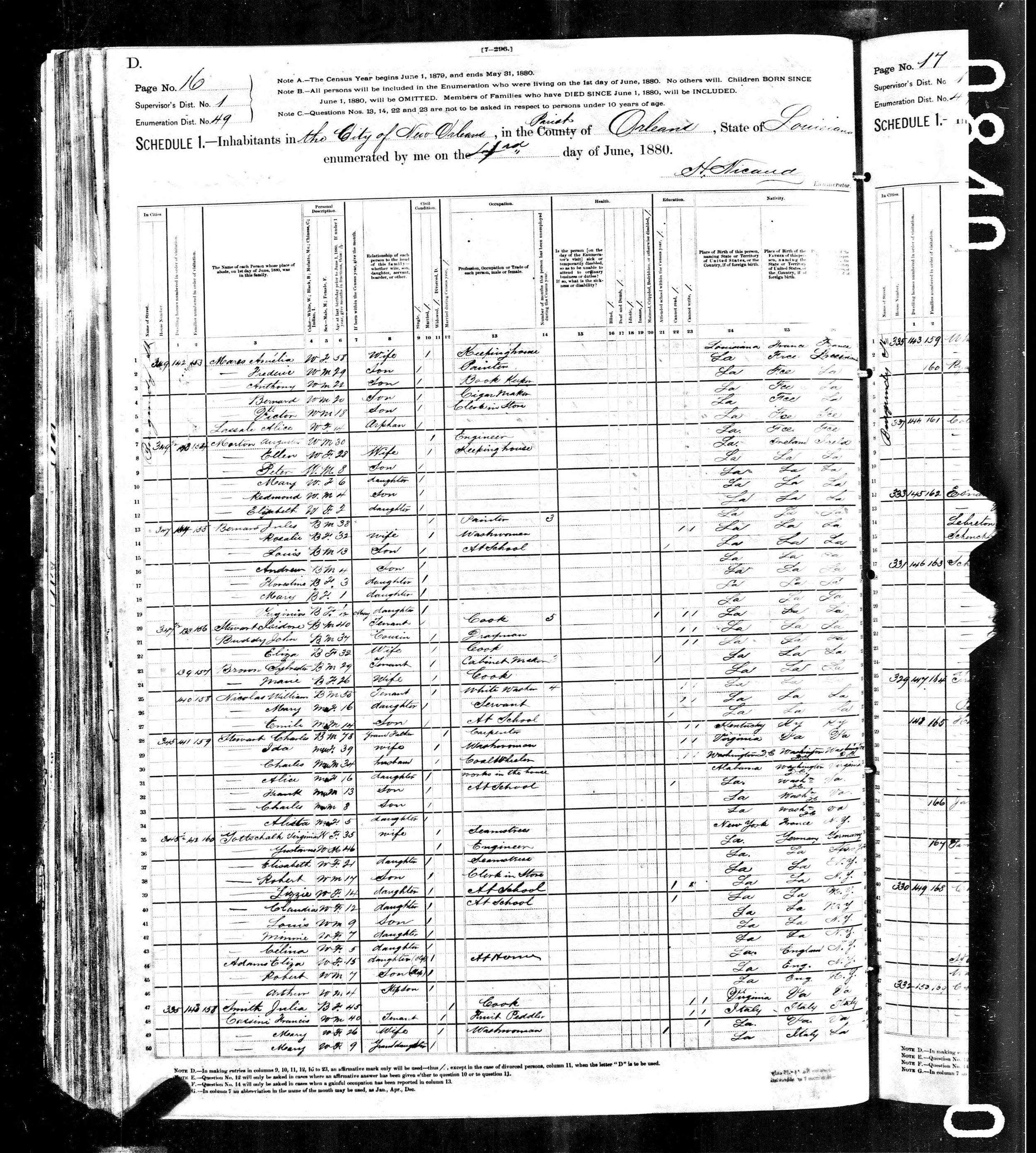
In her interview, Marie does mention her husband and children but gives a limited account. This could be due to the heavy emotional aspect and possible lack of trust with the interviewer who she tried to make leave at the beginning of the interview. Marie had 13 children but only 4 of them were living at the time of the interview and had been widowed.iv Marie was married Sylvester Brown, a cabinetmaker and they lived on Burgundy Street in the 1880s.v Marie used sewing to make money and worked as a cook, at the end of her interview she offers to cook for the interviewer the next time they come.vi Though, there is no information about her children, Marie notes on the death of her husband in regards to making sewing her livelihood after he died. Brown appears in interment registers in 1908 at around 50 years of age buried in Louisiana, by Marie’s account her husband died when they were of an older age.vii
Marie described herself and her as father, Celestin Pomprey or ‘Pomfrey’ according to her death certificate in 1944, as ‘creole’.viii On Marie’s death certificate her mother and father have slightly different spellings of their last names, her mother being ‘Pomprey’ and her father being ‘Pomfrey,’ this is due to how the certificates writing has been translated by the genealogy website. A Celestin is mentioned in the Louisiana Records of Enslaved People from 1820 described as being born in Louisiana and is Creole.ix Celestin was described as a runaway in the document and though the information about his plantation, occupation and enslaver is unavailable, the information of his sale value is noted as being 440.x Interestingly, Marie notes in her interview that her grandmother (maternal) disapproved of Celestin because he had been enslaved offering a different outlook into the contrasting attitudes between enslaved and non-enslaved Black people.xi
Marie’s mother Eliza is mentioned in her interviews but it was difficult to find further information about her aside from Marie’s own death certificate were Eliza is named ‘Eliza Pomprey.’xii A consistent theme during Marie’s interviews is her strong religious beliefs, however due to the privacy of church documents it was difficult to find Eliza or Marie’s traces in parish documents or baptism books.
An intriguing part of Marie’s interview is her grandmothers origins, who came from Saint Domingo (now known as Haiti) during the Haitian Revolution and great-grandmother was lived in Haiti but was born in Montenegro (for more information about the link between Haiti and Louisiana read Thomas Fiehrer’s article “Saint-Domingue/Haiti: Louisiana’s Caribbean Connection”).xiii Marie’s grandmother came from Haiti with the Duplantiers in which a Mrs Jule Duplantier her Godmother.xiv A Julie
Duplantier is mentioned, along with her husband Noel Duplantier, in a death record of her daughter, Marie Lousie Duplantier, in 1837 who had been born in New Orleans.xv Due to the nature of documents during the Haitian Revolution being lost or destroyed it is difficult to gather more information about Maries grandmother and great-grandmother. Nevertheless, this small insight into the mixed history of Louisiana offers invaluable information about the heritage of New Orleans.
In the interview there is a large section on Marie Laveau and Congo Square, who Marie expresses disdain for her, and the dances that take place, this part of the interview shows how close Marie was physically to this part of Louisiana culture, but separated in other ways connecting more with her religion.xvi This is proof that the interview may have been edited in a way to add or to project a certain image of New Orleans. The interviewer, Zoey Posey, is a white woman and does consistently make racially charged comments throughout her interviews towards her interviewees which may have altered how they were edited. There are also multiple interviews taken over 3 years that are quite short and typed by multiple people, C.B. Dillon and Rose St. Angelo, leaving it up to different individuals to interpret or change Marie’s narrative over time and to not include certain aspects of her life to fit their own racial bias.
Marie’s narrative among the collected interviews is important in understanding that the lives of Black American, either formally enslaved or children of formally enslaved, were not the same and were very diverse. Marie’s lineage connecting Louisiana and Haiti displays how New Orleans unique culture formed and gave an intriguing perspective on the lives of children of formally enslaved people.
i “Marie Brown,” 14 April 1944, Louisiana, Orleans, Death Records and Certificates, 1835-1954, (Last Accessed 18/03/2026) https://familysearch.org/ark:/61903/1:1:CT3F-CJT2?lang=en
ii Andrea Livesey, Voices of the Formerly Enslaved in Louisiana: The WPA Narratives (LSU Press, 2025), 268-9, ProQuest Ebook Central.
iii Marie’s residence at the time of the interviews, 1012 St Philip St New Orleans, LA 70116, USA, Google Maps.
iv Andrea Livesey, Voices of the Formerly Enslaved in Louisiana: The WPA Narratives (LSU Press, 2025), 268-9, ProQuest Ebook Central.
v “Marie Brown,” 1880, United States Federal Census, New Orleans, Louisiana (Last Accessed 18/03/2026) https://www.ancestry.com/sharing/57225364?mark=7b22746f6b656e223a223159744c6c734d50737363 4157472f375a2b435a4f336c3476475746773033784b6e63655669496462506b3d222c22746f6b656e5f76657273696f6e223a225632227d
vi “Marie Brown,” 1880, United States Federal Census, New Orleans, Louisiana (Last Accessed 18/03/2026) 657273696f6e223a225632227d
vii “Brown,” 10 January 1908, Louisiana, New Orleans, Interment Registers, 1836-1972, (Last Accessed 18/03/2026), https://www.familysearch.org/ark:/61903/1:1:4KFZ-J6T2?lang=en&cid=fs_copy viii Andrea Livesey, Voices of the Formerly Enslaved in Louisiana: The WPA Narratives (LSU Press, 2025), 271-2, ProQuest Ebook Central; “Marie Brown,” 14 April 1944, Louisiana, Orleans, Death Records and Certificates, 1835-1954, (Last Accessed 18/03/2026) https://familysearch.org/ark:/61903/1:1:CT3FCJT2?lang=en
ix “Celestin,” 4 December 1820, Louisiana, U.S, Record of Enslaved People, 1719-1820, (Last Accessed 18/03/2026), 657273696f6e223a225632227d
x “Celestin,” 4 December 1820, Louisiana, U.S, Record of Enslaved People, 1719-1820, (Last Accessed
18/03/2026), https://www.ancestry.com/sharing/57206657?mark=7b22746f6b656e223a22714b4d6138537972643633 4e5a7a637847314d4f626c2b7969626436554b4268624265712f346c316948593d222c22746f6b656e5f76657273696f6e223a225632227d
xi Andrea Livesey, Voices of the Formerly Enslaved in Louisiana: The WPA Narratives (LSU Press, 2025), 268-9, ProQuest Ebook Central. xii “Marie Brown,” 14 April 1944, Louisiana, Orleans, Death Records and Certificates, 1835-1954, (Last Accessed 18/03/2026) https://familysearch.org/ark:/61903/1:1:CT3F-CJT2?lang=en
xiii Andrea Livesey, Voices of the Formerly Enslaved in Louisiana: The WPA Narratives (LSU Press, 2025), 268-9, ProQuest Ebook Central; Fiehrer, Thomas. “Saint-Domingue/Haiti: Louisiana’s Caribbean Connection.” Louisiana History: The Journal of the Louisiana Historical Association 30, 4 (1989): 419–37.
xiv Andrea Livesey, Voices of the Formerly Enslaved in Louisiana: The WPA Narratives (LSU Press, 2025), 268-9, ProQuest Ebook Central. xv “Julie Duplantier,” 7 June 1837, Louisiana, Orleans, Death Records and Certificates, 1835-1954, (Last Accessed 18/03/2026), https://www.familysearch.org/ark:/61903/1:1:C1K9-JFMM?lang=en&cid=fs_copy
xvi Andrea Livesey, Voices of the Formerly Enslaved in Louisiana: The WPA Narratives (LSU Press, 2025), 268-9, ProQuest Ebook Central; Distance between Maries residence and Congo Square, Google Maps.
Bibliography
Livesey, Andrea. Voices of the Formerly Enslaved in Louisiana: The WPA Narratives. LSU Press, 2025.
ProQuest Ebook Central.
Thomas Fiehrer, “Saint-Domingue/Haiti: Louisiana’s Caribbean Connection.” Louisiana History: The Journal of the Louisiana Historical Association 30, 4 (1989): 419–37.
“Marie Brown,” 14 April 1944, Louisiana, Orleans, Death Records and Certificates, 1835-1954, (Last
Accessed 18/03/2026) https://familysearch.org/ark:/61903/1:1:CT3F-CJT2?lang=en
“Marie Brown,” 1880, United States Federal Census, New Orleans, Louisiana (Last Accessed
18/03/2026) https://www.ancestry.com/sharing/57225364?mark=7b22746f6b656e223a223159744c6c734d5073 73634157472f375a2b435a4f336c3476475746773033784b6e63655669496462506b3d222c22746f6b 656e5f76657273696f6e223a225632227d
“Celestin,” 4 December 1820, Louisiana, U.S, Record of Enslaved People, 1719-1820, (Last Accessed
18/03/2026),
https://www.ancestry.com/sharing/57206657?mark=7b22746f6b656e223a22714b4d613853797264
“Julie Duplantier,” 7 June 1837, Louisiana, Orleans, Death Records and Certificates, 1835-1954, (Last
Accessed 18/03/2026), https://www.familysearch.org/ark:/61903/1:1:C1K9JFMM?lang=en&cid=fs_copy
“Brown,” 10 January 1908, Louisiana, New Orleans, Interment Registers, 1836-1972, (Last Accessed
18/03/2026), https://www.familysearch.org/ark:/61903/1:1:4KFZ-J6T2?lang=en&cid=fs_copy Maries residence at the time of the interviews, 1012 St Philip St New Orleans, LA 70116, USA, Google Maps.